
Explore Amish Tripathi Books
Anoushka Nair•February 28, 2026•5 min read
When we talk about modern Indian authors who have redefined mythology for today’s readers, Amish Tripathi stands out as one of the most influential names.
Known for blending ancient legends with contemporary storytelling, he has built a unique space where mythology meets logic, politics, and human psychology.
Amish primarily writes in the genres of mythological fiction, historical fiction, and philosophical storytelling.
His writing style is simple yet powerful, making complex ideas accessible to a wide audience.
What makes his work special is how he reimagines divine characters as relatable humans shaped by choices, circumstances, and consequences.
Some of his most famous works include the bestselling Shiva Trilogy — The Immortals of Meluha, The Secret of the Nagas, and The Oath of the Vayuputras — which brought him massive recognition.
He later expanded his mythological universe with the Ram Chandra Series, a fresh and layered retelling of the Ramayana.
Additionally, books like Legend of Suheldev: The King Who Saved India and Immortal India further showcase his range across history and culture.
When we think of the Ramayana, we remember the core story we grew up hearing — how Sita was kidnapped by Raavan and taken to Lanka while she was in exile for fourteen years with Lord Ram and Lakshman.
We remember the great battle that followed, the war against Raavan and his army, and how Ram ultimately returned to Ayodhya after defeating him.
That is the version most of us know.
But what if the story wasn’t just about good versus evil?
What if there was more to understand beneath the surface?
In this blog, we’re going to talk about how Amish Tripathi completely reshaped our imagination with his Ram Chandra Series.
Through his writing, we don’t just read the Ramayana — we begin to understand it differently.
We see every character not as a symbol, but as a person.
We explore their pasts, their struggles, their motivations, and the circumstances that shaped their decisions.
This series isn’t just another retelling of the Ramayana.
It presents the same events, but from multiple perspectives.
Ram, Sita, and Raavan each get their own narrative space.
Their choices feel layered.
Their conflicts feel human.
And that’s what makes it so compelling.
While we know this is a fictional reinterpretation, the storytelling is so detailed and logically built that at times you almost pause and think — what if this could have happened this way?
The political depth, the personal backstories, the moral dilemmas — everything feels grounded, almost real.
It doesn’t replace the original epic.
But it makes you look at it with fresh eyes.
And that is the power of good storytelling.
The Series Includes:
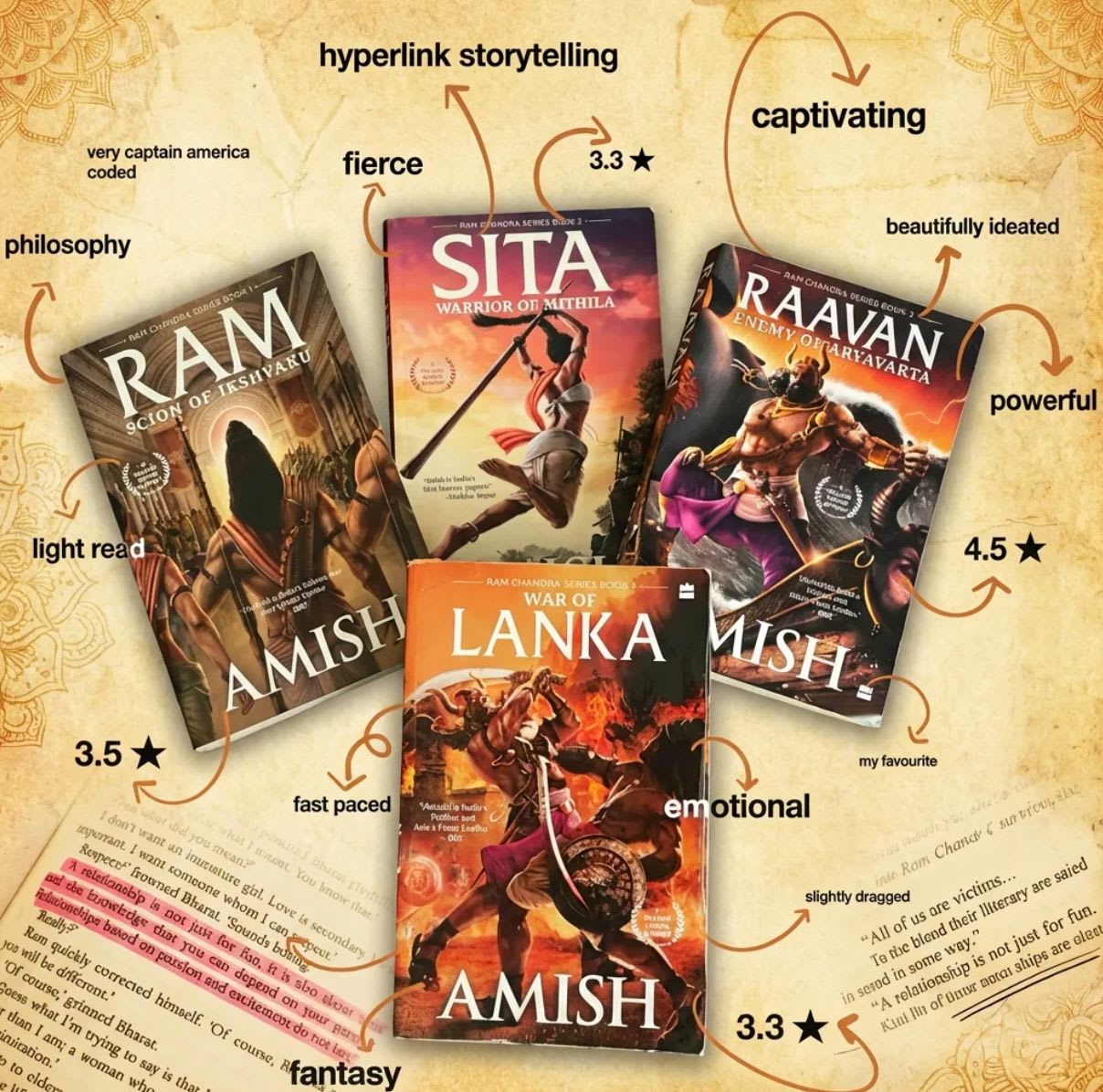
Ram: Scion of Ikshvaku
In this book, Ram is portrayed not only as a divine figure but as a principled and disciplined leader navigating political challenges and moral responsibility.
What makes it powerful is that we see him grow — not just as a hero, but as a human making difficult decisions.
It doesn’t diminish the Ram we respect; instead, it adds dimension to him.
It shows the weight of duty, leadership, and sacrifice in a way that feels relatable.
Sita: Warrior of Mithila
This book was truly refreshing.
Sita emerges as intelligent, strategic, and emotionally strong.
She is not portrayed as passive or dependent, but as someone capable of leadership, strength, and resilience.
The narrative gives her agency, showing her courage and capability even in the most difficult circumstances.
It presents a perspective that feels empowering without being disrespectful to tradition — simply expanding it.
Raavan: Enemy of Aryavarta
This was perhaps the most thought-provoking book in the series for me.
It doesn’t justify Raavan’s actions, nor does it attempt to rewrite his role.
But it does explore how ambition, ideology, love, ego, and circumstance shaped him.
We see not just the ruler of Lanka, but the person behind the decisions.
And that’s what makes it powerful.
Understanding a character’s backstory doesn’t mean agreeing with them.
It simply means seeing the journey that led them there.
This book made me reflect more deeply than I expected.
At moments, I even found myself researching certain elements, curious to know how much was rooted in traditional texts and how much was creative liberty.
That curiosity is a sign of strong storytelling.
War of Lanka
The final book ties everything together.
The overlapping timelines converge, perspectives collide, and the consequences of every decision unfold.
It feels epic, intense, and emotionally heavy — not just a battle of armies, but a clash of beliefs and ideologies.
What I truly appreciate about this series is how accessible it feels.
You don’t need to approach it strictly as mythology.
You can approach it as layered, character-driven storytelling.
The pacing feels modern.
The characters feel real.
The moral dilemmas feel relevant even today.
It is mythology, yes.
But it reads like a contemporary epic.
If you enjoy:
• Character-driven storytelling
• Multiple perspectives
• Political depth mixed with philosophy
• Strong reinterpretations of ancient tales
Then the Ram Chandra Series is worth experiencing.
At Rent a Chapter, series like this are perfect to explore one book at a time.
You don’t have to rush through an epic.
You can discover each perspective slowly and let the story unfold in its own rhythm.
Because some stories aren’t just about the ending.
They’re about understanding every side before you get there.
Known for blending ancient legends with contemporary storytelling, he has built a unique space where mythology meets logic, politics, and human psychology.
Amish primarily writes in the genres of mythological fiction, historical fiction, and philosophical storytelling.
His writing style is simple yet powerful, making complex ideas accessible to a wide audience.
What makes his work special is how he reimagines divine characters as relatable humans shaped by choices, circumstances, and consequences.
Some of his most famous works include the bestselling Shiva Trilogy — The Immortals of Meluha, The Secret of the Nagas, and The Oath of the Vayuputras — which brought him massive recognition.
He later expanded his mythological universe with the Ram Chandra Series, a fresh and layered retelling of the Ramayana.
Additionally, books like Legend of Suheldev: The King Who Saved India and Immortal India further showcase his range across history and culture.
When we think of the Ramayana, we remember the core story we grew up hearing — how Sita was kidnapped by Raavan and taken to Lanka while she was in exile for fourteen years with Lord Ram and Lakshman.
We remember the great battle that followed, the war against Raavan and his army, and how Ram ultimately returned to Ayodhya after defeating him.
That is the version most of us know.
But what if the story wasn’t just about good versus evil?
What if there was more to understand beneath the surface?
In this blog, we’re going to talk about how Amish Tripathi completely reshaped our imagination with his Ram Chandra Series.
Through his writing, we don’t just read the Ramayana — we begin to understand it differently.
We see every character not as a symbol, but as a person.
We explore their pasts, their struggles, their motivations, and the circumstances that shaped their decisions.
This series isn’t just another retelling of the Ramayana.
It presents the same events, but from multiple perspectives.
Ram, Sita, and Raavan each get their own narrative space.
Their choices feel layered.
Their conflicts feel human.
And that’s what makes it so compelling.
While we know this is a fictional reinterpretation, the storytelling is so detailed and logically built that at times you almost pause and think — what if this could have happened this way?
The political depth, the personal backstories, the moral dilemmas — everything feels grounded, almost real.
It doesn’t replace the original epic.
But it makes you look at it with fresh eyes.
And that is the power of good storytelling.
The Series Includes:
Ram: Scion of Ikshvaku
In this book, Ram is portrayed not only as a divine figure but as a principled and disciplined leader navigating political challenges and moral responsibility.
What makes it powerful is that we see him grow — not just as a hero, but as a human making difficult decisions.
It doesn’t diminish the Ram we respect; instead, it adds dimension to him.
It shows the weight of duty, leadership, and sacrifice in a way that feels relatable.
Sita: Warrior of Mithila
This book was truly refreshing.
Sita emerges as intelligent, strategic, and emotionally strong.
She is not portrayed as passive or dependent, but as someone capable of leadership, strength, and resilience.
The narrative gives her agency, showing her courage and capability even in the most difficult circumstances.
It presents a perspective that feels empowering without being disrespectful to tradition — simply expanding it.
Raavan: Enemy of Aryavarta
This was perhaps the most thought-provoking book in the series for me.
It doesn’t justify Raavan’s actions, nor does it attempt to rewrite his role.
But it does explore how ambition, ideology, love, ego, and circumstance shaped him.
We see not just the ruler of Lanka, but the person behind the decisions.
And that’s what makes it powerful.
Understanding a character’s backstory doesn’t mean agreeing with them.
It simply means seeing the journey that led them there.
This book made me reflect more deeply than I expected.
At moments, I even found myself researching certain elements, curious to know how much was rooted in traditional texts and how much was creative liberty.
That curiosity is a sign of strong storytelling.
War of Lanka
The final book ties everything together.
The overlapping timelines converge, perspectives collide, and the consequences of every decision unfold.
It feels epic, intense, and emotionally heavy — not just a battle of armies, but a clash of beliefs and ideologies.
What I truly appreciate about this series is how accessible it feels.
You don’t need to approach it strictly as mythology.
You can approach it as layered, character-driven storytelling.
The pacing feels modern.
The characters feel real.
The moral dilemmas feel relevant even today.
It is mythology, yes.
But it reads like a contemporary epic.
If you enjoy:
• Character-driven storytelling
• Multiple perspectives
• Political depth mixed with philosophy
• Strong reinterpretations of ancient tales
Then the Ram Chandra Series is worth experiencing.
At Rent a Chapter, series like this are perfect to explore one book at a time.
You don’t have to rush through an epic.
You can discover each perspective slowly and let the story unfold in its own rhythm.
Because some stories aren’t just about the ending.
They’re about understanding every side before you get there.
Share this article: